Red Snapper Rules in the Gulf, Explained in Plain English
No fish in the Gulf generates more questions, more excitement, or more confusion than red snapper. Anglers hear that the season is open, then hear from a buddy that it is closed, and both heard right, because the answer depends on whose boat you are standing on and how far from shore it floats.
The rules genuinely make sense once you see the two or three moving parts. Here is the plain English version we give guests out of St. Petersburg, current in spirit every year even as the exact dates shift.
When can you keep red snapper in the Gulf?
Only during an open season, and there are two different ones. Federally permitted charter boats fish the federal for hire season, set by NOAA each year, which typically opens the first of June and runs deep into summer. Private recreational boats fish a separate season that Florida sets for its anglers. Within any open season the typical rules are two red snapper per person per day with a 16 inch minimum length. On a charter, the boat’s permits and the captain’s knowledge decide everything, so your only job is booking inside the window. Exact dates reset every year, so check current announcements or simply ask the boat.
That split, two seasons for two kinds of boats, is the source of nearly all the confusion, and it exists for a reason worth understanding.
The nine mile line: state versus federal waters
Off Florida’s Gulf coast, state waters run out nine nautical miles, and federal waters begin beyond that. The distinction matters enormously for snapper, because the quality red snapper grounds off St. Petersburg sit in 80 to 140 feet of water, which means 25 miles or more offshore, well into federal territory. Florida writes the rules inside nine miles, NOAA writes them beyond, and a fish that is legal on one side of an invisible line can be illegal on the other.
For practical purposes out of St. Petersburg, red snapper is a federal waters fishery. That is why the federal season, the federal permits, and the federal gear rules are the ones that shape your charter.
Why charter boats and private boats have different seasons
The Gulf red snapper quota gets divided among groups, and the charter fleet with federal reef fish permits is managed as its own sector with its own season, announced each spring. Those permits are limited in number, which is why not every boat with rods can legally put federal water snapper in your cooler, and why we tell everyone to confirm a boat is federally permitted before booking a summer snapper trip.
Riding on a permitted charter comes with real advantages: you fish under the boat’s licensing, the for hire season has historically been generous, and the captain carries the burden of staying current on every rule. Your buddy trailering his own boat fishes the state set private season instead, and the two calendars rarely match exactly. Neither of you is wrong, you are just in different sectors.
Limits, sizes, and the gear the law expects
Inside an open season, the standing recreational rules are two red snapper per person per day, minimum 16 inches total length, counted within the boat’s overall math on a charter. Snapper from deep water often come up with expanded swim bladders, unable to swim back down, so federal rules require Gulf reef fish boats to carry a descending device or venting tool rigged and ready, and good crews use them without being asked.
Those release tools are not paperwork trivia, they are why the fishery keeps improving: short fish and out of season fish returned to depth actually survive to be caught again. Expect circle hooks with natural baits on the reef grounds too, another requirement built around keeping released fish alive.
Why the dates move every year
Red snapper is one of conservation’s genuine success stories, rebuilt from a badly overfished stock to the point that fish over ten pounds are a regular event off St. Petersburg. The management that got it here works on quotas: scientists update the stock picture, managers set the year’s allowable catch, and season lengths follow from how fast each sector is projected to catch its share. Hence the moving dates, announced each spring.
For trip planning, the practical takeaways are simple. June and July are the heart of the charter season and the dates everyone wants, so book those weeks early. And when snapper season is closed, the same bottom still holds gag and red grouper in their windows, mangrove snapper, hogfish, and amberjack, which is why offshore trips here stay worth running most of the year.
Bottom Line
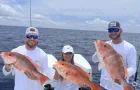
Red snapper rules boil down to this: the fish live in federal water, federally permitted charters fish a NOAA set summer season that typically opens in early June, private boats follow Florida’s separate calendar, and two fish at 16 inches is the standing per person math. Book a permitted boat inside the window and the regulations become the captain’s problem instead of yours. Inverted Fishing Charters runs federally permitted offshore trips out of St. Petersburg, and our June and July snapper dates go first every year. If a summer cooler of red snapper is on your list, claim a date early.
Related reading: Sandbar Trips from St. Petersburg: Shell Key, Egmont Key, and More, Private Sunset Cruises in St. Petersburg: How to Plan One